


-
Seyi Shay Sparks Debate Over Church Music and Colonial-Era Hymns

Nigerian singer and songwriter Seyi Shay has ignited conversation online after sharing her personal experience with religious practices that led her to leave her former church.
In a candid Instagram Story, the Right Now singer revealed that a church leader’s criticism of modern gospel music was the breaking point for her.
According to Shay, the leader insisted that the congregation should only sing hymns and songs directly from scripture, dismissing contemporary praise and worship songs as inappropriate.
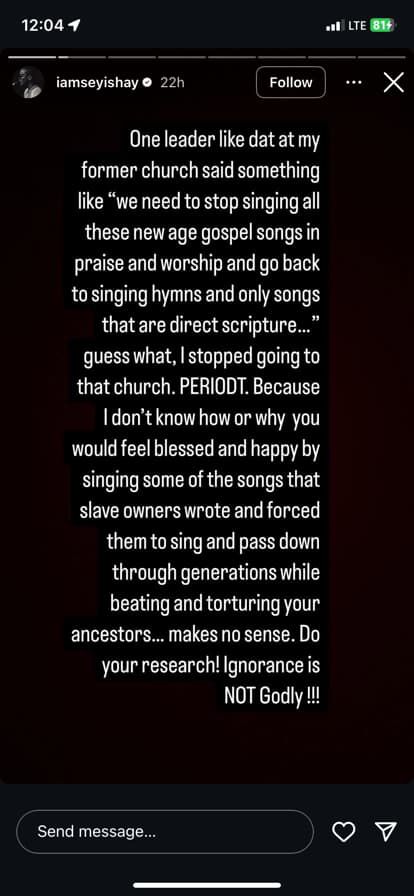
“One leader like that at my former church said something like, ‘We need to stop singing all these new age gospel songs in praise and worship and go back to singing hymns and only songs that are direct scripture.’ Guess what, I stopped going to that church. PERIODT,” she wrote.
She further took a strong stance against traditional hymns with historical ties to slavery and colonialism, questioning why people continue to sing songs written or endorsed by slave owners.
“I don’t know how or why you would feel blessed and happy by singing some of the songs that slave owners wrote and forced them to sing and pass down through generations while beating and torturing your ancestors… makes no sense. Do your research! Ignorance is NOT Godly!!!”
Anticipating backlash, the artist clarified in a follow-up post that she was not condemning all hymns, but rather encouraging critical reflection and openness to new, spiritually meaningful songs, including those based on scripture.
“Not ALL hymns were written by slave owners ooo! But a lot of them were. In some cases you’re better off making up your own praise and worship songs/hymns (based on scripture if you prefer),” she added.
Seyi Shay’s comments have sparked debate on tradition vs. evolution in church music, with many praising her for challenging norms, while others defend the spiritual depth of classical hymns.
The conversation reflects a broader dialogue in Nigerian and global Christian communities about how culture, history, and spirituality intersect in worship.
