


In a dramatic turn that has caught global attention, Kanye West, now legally known as Ye, has issued a sweeping public apology, linking years of controversy and offensive behaviour to a long-undiagnosed brain injury.
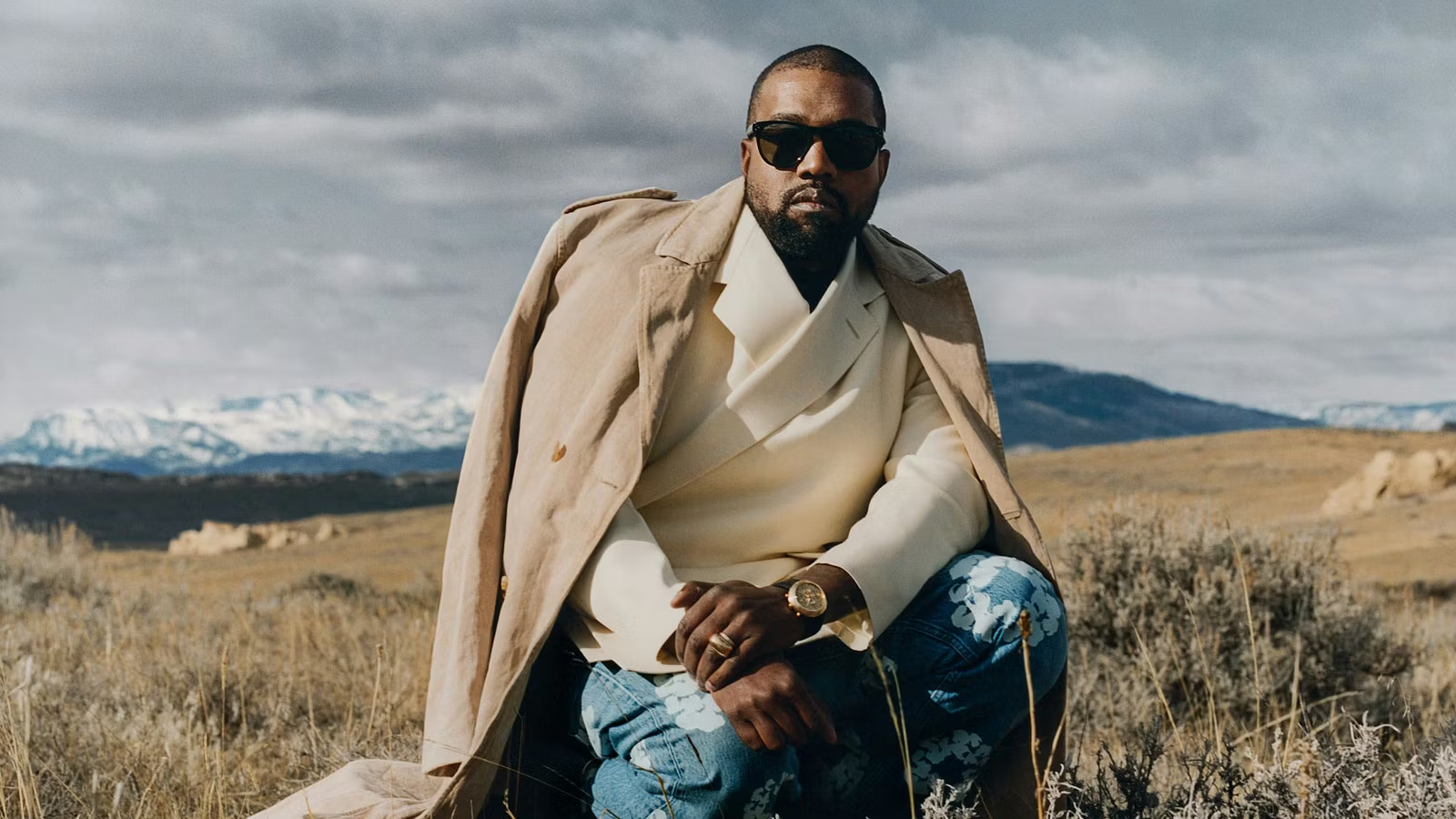
On January 26, 2026, the 48-year-old artist took out a striking full-page advert in The Wall Street Journal titled “To Those I’ve Hurt,” where he addressed the backlash surrounding his past antisemitic statements and erratic conduct. The message marked one of Ye’s most direct and detailed attempts yet at accountability.
In the open letter, Ye firmly rejected labels that have followed him in recent years, stating clearly, “I love Jewish people,” and denying that he is either a Nazi or an antisemite.
He expressed deep regret over his actions, including the use of the swastika and the sale of merchandise bearing the symbol, describing those moments as the result of what he called a deeply “fractured state.”
According to Ye, that fractured state can be traced back more than two decades. In the advert, he revealed that a car accident 25 years ago left him with injuries that went far beyond a broken jaw.
As he explained, the damage to his brain, specifically the right frontal lobe, was overlooked at the time, setting off a chain of consequences that would only be fully understood years later.
The rapper wrote:
“25 years ago, I was in a car accident that broke my jaw and caused injury to the right frontal lobe of my brain. At the time, the focus was on the visible damage – the fracture, the swelling, and the immediate physical trauma. The deeper injury, the one inside my skull, went unnoticed.
Comprehensive scans were not done, neurological exams were limited, and the possibility of a frontal-lobe injury was never raised. It wasn’t properly diagnosed until 2023. That medical oversight caused serious damage to my mental health and led to my bipolar type-1 diagnosis.”
Ye went on to describe the nature of bipolar disorder, explaining how denial often becomes part of the illness and how mania can distort one’s sense of reality.
“Bipolar disorder comes with its own defence system. Denial. When you’re manic, you don’t think you’re sick. You think everyone else is overreacting. You feel like you’re seeing the world more clearly than ever, when in reality you’re losing your grip entirely.”
He also reflected on the stigma surrounding mental illness and the very real dangers it poses, citing global health data on reduced life expectancy and higher mortality rates among people living with bipolar disorder.
“Once people label you as ‘crazy’, you feel as if you cannot contribute anything meaningful to the world… this is a very serious debilitating disease you can die from.”
Opening up further, Ye admitted that during his untreated episodes, he lost touch with reality and hurt people closest to him.
“I lost touch with reality. Things got worse the longer I ignored the problem. I said and did things I deeply regret… Looking back, I became detached from my true self.”
Addressing one of the most controversial chapters of his recent past, Ye acknowledged his use of Nazi imagery, writing:
“In that fractured state, I gravitated toward the most destructive symbol I could find, the swastika, and even sold t-shirts bearing it… I regret and am deeply mortified by my actions in that state, and am committed to accountability, treatment, and meaningful change. It does not excuse what I did, though. I am not a Nazi or an antisemite. I love Jewish people.”
Beyond the Jewish community, Ye also turned inward, directing a heartfelt apology to the Black community, which he described as the core of his identity.
“To the Black community – which held me down through all of the highs and lows and the darkest of times… I am so sorry to have let you down. I love us.”
The rapper revealed that in early 2025, he experienced a prolonged manic episode that lasted four months and nearly destroyed his life.
“In early 2025, I fell into a four-month long manic episode of psychotic, paranoid and impulsive behaviour that destroyed my life… there were times I didn’t want to be here anymore.”
He clarified that bipolar disorder is episodic, stressing that clarity often returns once an episode passes—sometimes leaving behind devastating consequences.
“When you are not in an episode, you are completely ‘normal’. And that’s when the wreckage from the illness hits the hardest.”
Kanye West credited his wife for encouraging him to finally seek help after hitting rock bottom, adding that unexpected support came from online communities.
“I have found comfort in Reddit forums of all places… I read their stories and realised that I was not alone.”
He also criticised previous medical assessments that dismissed his condition, noting that he was often told he was not bipolar.
Now, according to Ye, things are changing. He says he is finding balance through medication, therapy, exercise, and healthier living and is redirecting his energy into creative work meant to have a positive impact.
“My words as a leader in my community have real global impact and influence. In my mania, I lost complete sight of that… I am pouring my energy into positive, meaningful art.”
Despite the deeply personal nature of the apology, Ye made it clear he is not seeking pity.
“I’m not asking for sympathy, or a free pass, though I aspire to earn your forgiveness… I write today simply to ask for your patience and understanding as I find my way home.”
Reacting to the statement, the Anti-Defamation League (ADL) described the apology as “long overdue,” while cautioning that it does not erase the harm caused by years of hate-filled rhetoric.
Kanye West’s public reckoning comes after a turbulent period that saw his career suffer major setbacks, including being dropped by agents in February 2025 following social media posts praising Adolf Hitler and identifying himself as a Nazi. His online store on Shopify was also taken down after he sold merchandise featuring swastikas.
With this latest statement, Ye appears to be attempting a reset—one rooted in explanation, remorse and a promise of change—though whether the public is ready to forgive remains an open question.
Ye, fka Kanye West, takes out a full-page in the Wall Street Journal to apologize to the Black community, and for antisemitism:
“I lost touch with reality” pic.twitter.com/Po8s4gNz5P
— philip lewis (@Phil_Lewis_) January 26, 2026